
A Letter to the 56th Speaker of the US House of Representatives
A Citizen’s response to the actions of the Congressional Republican Party and President Trump
Lori Block
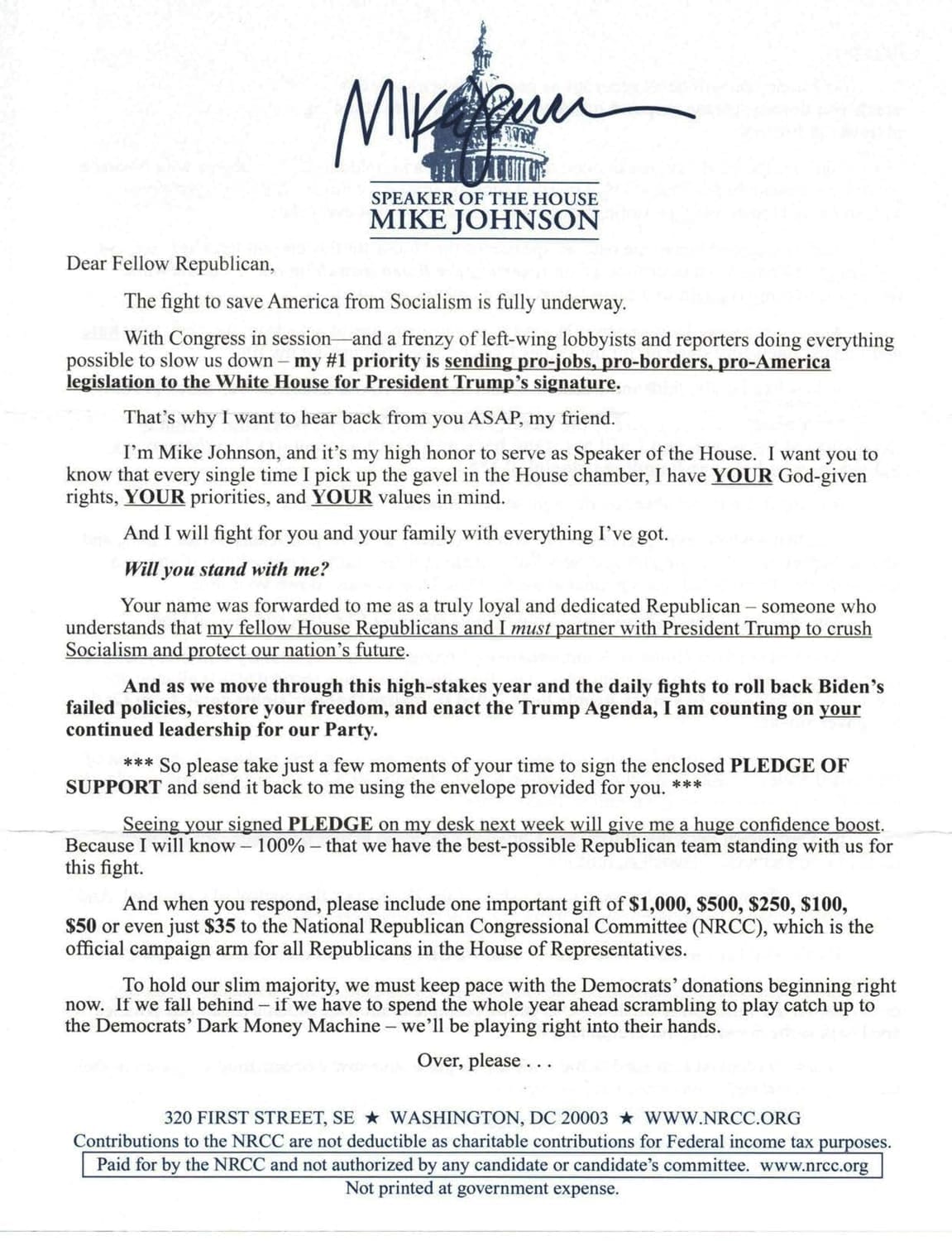
The Honorable Mike Johnson
Speaker of the House
U.S. House of Representatives
Washington, D.C. 20515
Dear Speaker Johnson,
I am writing in response to your recent fundraising letter. As a fellow American who values evidence, history, and the full breadth of the Constitution, I feel compelled to respond to several of the claims made therein. My intent is not adversarial but stems from concern—for our country, for the truth, and for the increasing disconnect between rhetoric and reality within the Republican Party.
I’ll address a few of the recurring points you either made or implied in your letter.
The “Big Beautiful Bill” will reduce the deficit.
That's a nice aspiration, and one the GOP and candidate Trump campaigned on, but is not reality. The proposed budget relies on the same fiscal sleight of hand we’ve seen for years from the GOP: deep tax cuts for corporations and the wealthy, paired with vague promises of “waste reduction” in social programs. Only this time, the promises aren’t vague, but specific.
Trickle-down economics didn't reduce the deficit in the 1980s, nor in the 2000s, nor after the 2017 tax cuts. Why should it work now? A plan that cuts IRS enforcement, underfunds public services, and boosts military spending isn’t a deficit reducer—it’s an ideological wishlist disguised as fiscal policy.
And tax cuts for tanning beds and silencers? Where did these ideas come from?
All joking aside, the Congressional Budget Office, financial agencies, and other experts, consider the Big Beautiful Bill to be a budget buster.
Part of the “problem” is that it’s being reported that the Medicaid cuts aren't slated to go into effect until 2029, so that you, your fellow Republicans in Congress and across the country, and this Administration can try to avoid responsibility ahead of mid-terms and the next Presidential election. But the real problem is that, according to Congressional Budget Office estimates, the tax cut extensions alone will cost at least $4.6 trillion over the next ten years. And that’s not counting the tanning beds and silencers.
Trump's immigration policies are legal.
During the first Trump administration, some of his immigration policies—like family separation and the Muslim ban—were struck down by the courts or reversed due to legal and humanitarian outrage. Even if some policies were “technically” legal, legality does not equal morality, and it certainly doesn’t equal effectiveness. The courts exist precisely to test the boundaries of executive overreach. You likely recall this concept from civics class.
However, others in the Administration appear to have skipped civics classes, as evidenced by the fact that Trump 2.0 is going even further in his draconian immigration policies and the myriad instances in which he is defying the courts.
At the top of the list is the illegal invocation of the Alien Enemies Act, which courts all the way up to the Supreme Court have put the brakes on. Yet Trump wants to go further—by revoking habeas corpus. Despite what Secretary Noem believes, only Congress has that right. (Of course, Noem also believes that habeas corpus is a right granted to the President under the Constitution, when you and I both know it’s a right granted to “We the People”. Yet you’ve stayed silent on this point.)
The Administration is also outside legal boundaries with regard to asylum restrictions at the southern border and in seeking to withhold funds from “sanctuary cities.” I could continue on this topic but since there’s so much more to cover, I’ll move on.
Biden’s border policies led to a crime wave.
There is no credible evidence linking immigration with a surge in crime. In fact, numerous studies show that immigrants—undocumented or not—commit crimes at lower rates than native-born citizens. Border issues are complex and deserve serious debate, not fearmongering. The real “surge” has been in misinformation and xenophobia (“they’re eating the cats; they’re eating the dogs”) not criminal activity.
Our constitutional rights are granted by God.
This is a common talking point, but it's also theologically confusing and constitutionally incorrect. The Constitution doesn't cite divine authority; it derives its power from “We the People.” The Founders were wise enough to ensure that our rights come from laws made by humans—not interpretations of divine will, which tend to vary widely depending on who’s doing the interpreting. If God were the ultimate source of our rights, we'd likely be living under vastly different laws—and several religious factions would be in court full-time arguing over the fine print.
This is not a trivial point. Scholars point out that The Enlightenment, an intellectual movement emphasizing reason and individual rights, profoundly influenced the American Revolution. Its core ideas, such as natural rights, social contract theory, and (particularly important today) separation of powers, provided a philosophical basis for colonial resistance to British rule and shaped the revolutionary mindset. Key Enlightenment also significantly impacted the Declaration of Independence and the structure of our government.
The U.S. is a Judeo-Christian nation.
Culturally, perhaps, but constitutionally? Absolutely not. The First Amendment is quite clear: “Congress shall make no law respecting an establishment of religion.” The Founders, some of whom were deists (as opposed to theists), deliberately built a secular government.
A little-known fact from a little-known treaty, the Treaty of Tripoli (1796): While this treaty secured American shipping rights in the Mediterranean Sea, it’s significant for its declaration that the government of the United States was “in no sense, founded on the Christian religion.”
The values you often refer to—such as compassion, justice, and dignity—are not exclusive to any one faith or even exclusive to faith. They are, thankfully, human values.
Democrats are socialists.
I wish I had a dollar for every time someone shouted “socialism” at basic social safety nets like Medicare, Social Security, Medicaid, or even public libraries. Equating a party that supports regulated capitalism and progressive taxation with socialism may be good political theater, but it’s intellectually lazy. For the sake of serious policy debate, it’s important to use accurate terms. (And if you're worried about government overreach, you might take a closer look at the recent state-level attempts to control books, classrooms, and reproductive rights.)
ICYMI… Medicare and Social Security—both created by a Democratic President—are wildly popular with the American public; so too, Medicaid, as people begin to understand how the program works and who it covers. If you and your fellow Republicans in Congress doubt that, then why does your “Big Beautiful Bill” delay when the cuts in Medicaid will go into effect? Your constituents in particular, 38% of whom are enrolled in Medicaid, will be hurt by any changes to Medicaid that impact eligibility or benefits.
Democrats want to legalize late-term abortion everywhere.
This is a gross distortion. Most Democrats support Roe v. Wade standards—abortion access with reasonable limits, especially after viability. Late-term abortions are exceedingly rare and almost always due to tragic medical circumstances. To paint this issue with a broad brush is not only dishonest, it's cruel to the families who have faced these impossible decisions.
Speaker Johnson, I urge you—as someone in a position of immense power—to lead with facts, not talking points. Political theater may rile up a base, but it doesn’t govern a nation. While I recognize your need to engage in fundraising, this letter is a disservice to the American people all across the political spectrum. We deserve leadership grounded in facts and in keeping with one of your core values, compassion.
Sincerely,
Lori Block
Argyle, TX