
The Dreams of a Palestinian Simon Bolivar
Part 1: Nayib Bukele's Rise from Outsider to President of El Salvador
Ben Angel
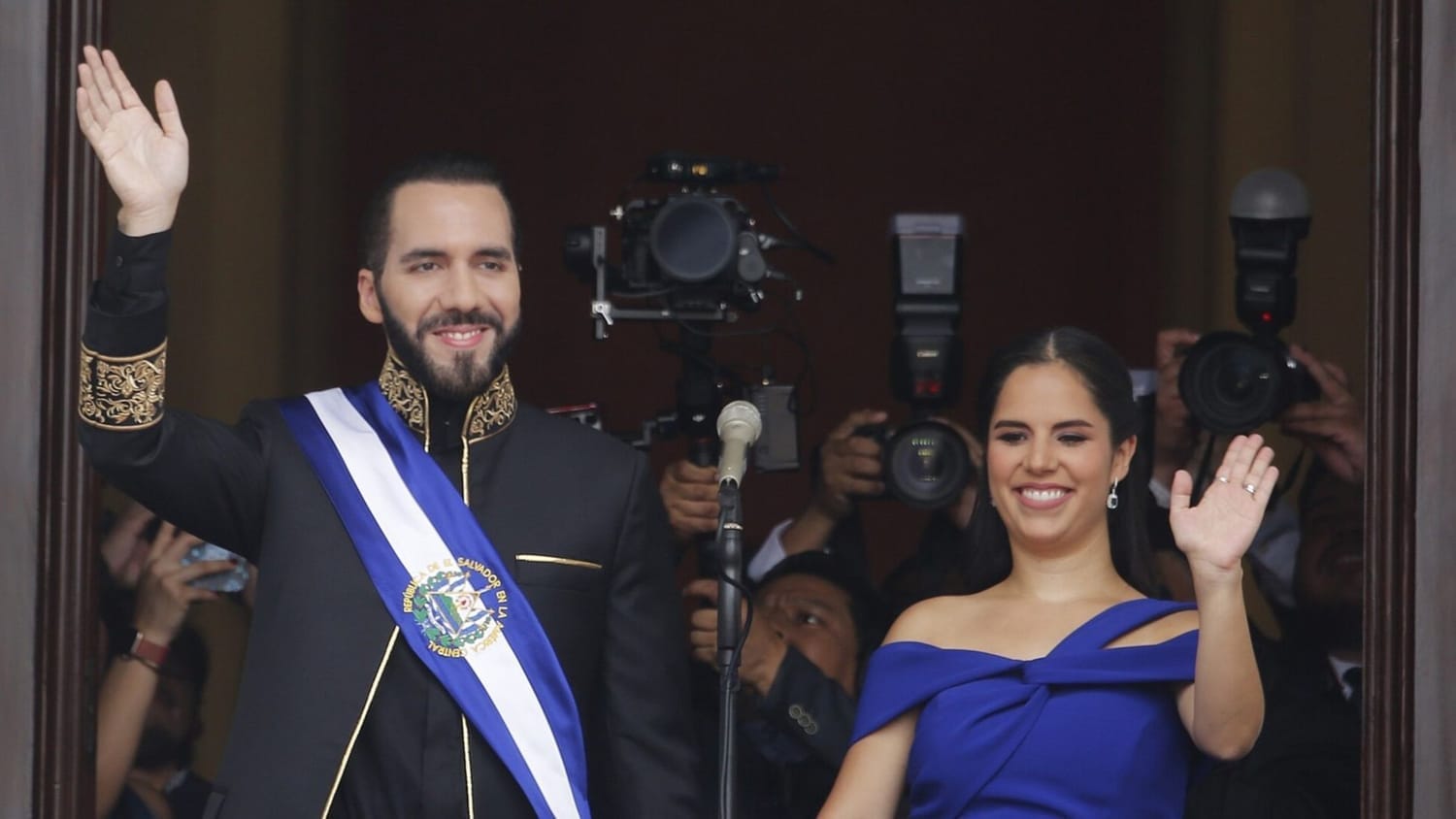
Nayib Bukele is not a common name in the Spanish-speaking world. It’s certainly not a name you’d expect to find in front of the words, “President of El Salvador.” Nevertheless, Nayib Armando Bukele Ortez was born in San Salvador on July 24, 1981, the son of businessman Armando Bukele Kattan and Olga Marina Ortez.
Nayib, often likened to the Donald Trump of Central America, is like the US president a third-generation citizen of his country – his grandparents, Humberto Bukele Salman and Victoria Kattan, were part of a wave of Palestinian Christians who left Bethlehem for El Salvador in the 1920s and 1930s. They likely obtained citizenship before the country passed laws restricting immigration from a rapidly destabilizing British Palestine in 1933.
The Palestinians who successfully settled in San Salvador before the door closed soon faced discrimination in their new homeland, which transformed them into an insular community. Families like Humberto Bukele’s survived on the margins of an increasingly stratified society through the start of the Reagan-era civil war, about the time that Nayib was born in 1981.
For the first eight years of Nayib’s life, his family, like most who lived in this late Cold War battleground state, remained as low-key as they could. Once the shooting formally stopped, though, the conflict transformed into a far less deadly political drama. And of course, a well-funded war of words meant there would be a need for a different kind of soldier in El Salvador.
This was where Nayib found his opportunity. After diverting from his initial foray into law toward a career in business management, he soon achieved commercial success in providing promotional services and advertising. When the left-wing Farabundo Marti National Liberation Front (FMLN) Party toppled the conservative Nationalist Republican Alliance (ARENA), he became a leading government contractor for the services he offered.
This ultimately led to him joining the FMLN when he turned 30. He ran in the mayoral race for the suburb of Nuevo Cuscatlan in 2012 and won through the use of social media and his ability to connect with younger voters. His focus on education for the underprivileged turned him into a star in San Salvador, and in 2015, he ran against ARENA’s textile entrepreneur champion Edwin Zamora, and eked out a win with 50.4 percent of the vote.
Although still one of the youngest Mayors of San Salvador, once he took office he saw the needs of the people a little differently. He soon became a crusader against crime on the streets, employing security cameras and urban renewal in his campaign. No longer seen as the champion of the underprivileged, he instead concentrated his youthful energy fighting criminal gangs. This turned his liberal-leaning FMLN colleagues, and El Salvador’s FMLN President Sanchez Ceren, away from him, particularly after an altercation with Mayoral trustee Xochitl Marchelli resulted in verbal abuse and Bukele assaulting her with an apple. An ethics tribunal expelled him from the party in late 2017.
After expulsion, he decided to run against President Sanchez Ceren’s chosen successor Hugo Martinez Bonilla, his foreign minister. Calling the FMLN nothing more than another “electoral machine at the service of the oligarchies,” like its rival ARENA, he announced that he would create a new movement. Still in his late 30s, he again tapped into the younger voters of El Salvador by calling his party “Nuevas Ideas,” or New Ideas, and promoted his candidacy with the hashtag #HagamosHistoria (“let’s make history”). Despite public aspirations to create a party with a horizontal political organization, much of its activities necessarily revolved around his candidacy.
The most important step to getting Bukele on the ballot was getting 50,000 signatures on a petition to accredit his new party to the Supreme Electoral Tribunal (TSE), which was the focus of the last days as San Salvador’s mayor. He achieved this a week after leaving office at the end of his term. TSE, however, dragged its feet on verifying the signatures turned in on Nuevas Ideas petition, and as the registration deadline approached for candidates to enter the running for the Feb. 3, 2019, election, he vowed to sue the TSE “before international bodies.” Finally, Bukele opted to align his movement with the center-left Democratic Change (CD) party.
Within a couple of weeks, an old challenge to the legitimacy of the party came before the country’s Supreme Court of Justice, and as a result, the CD was declared ineligible to field a candidate. Bukele became more determined, and in desperation approached the Grand Alliance for National Unity (GANA), a conservative party that splintered off from ARENA many years earlier.
Bukele’s jump to a conservative party had been completely unexpected and went surprisingly well. With a populist message, he took something like 90 percent of the vote for candidacy representing GANA in the presidential race. Because of the support of not only this one-time splinter party, but also the delegitimized CD party and his own movement that finally was legitimized by the TSE a month after his GANA victory, Bukele had become a formidable third-party challenger, facing off against ARENA’s supermarket chain owner Juan Carlos Calleja Hakker, and former Foreign Minister Martinez representing the FMLN.
Political observers couldn’t help but notice the parallel with US President Donald J. Trump, who struggled to get onto a ticket to face off against the Salvadoran equivalent of the Secretary of State. He was also young, energetic, seemed rebellious, and spoke out against the “partycracy,” a local version of the so-called “deep state” whose opposition had energized the radical right in the United States. The hashtag #QueDevuelvanLoRobado, or “Return What Was Stolen” overtook the country’s social media during that year’s elections. The message wasn’t far from “Make El Salvador Great Again.”
Perhaps his most important campaign promise involved his so-called Territorial Control Plan, which sought to reduce crime, especially the national homicide rate. Having peaked in 2015 at 107 deaths per 100,000, the threat remained high at 38 per 100,000 under the lingering threat of such street gangs as MS-13 and Barrio 18, which retained control over several parts of the country.
Bukele’s plan he presented during the election called for a three-prong approach. The first prong, “prevention,” sought to keep young people from joining gangs through social inclusion measures (scholarships, etc.). The second prong he called “combat,” which called for the National Civil Police and the country’s armed forces to overwhelm the gangs. The third prong he called “reintegration,” which sought to transform prisoners into productive members of society. The offer seemed like a thoughtful approach to the nation’s crime problem, and coupled with a number of ambitious “flagship infrastructure projects” (a proposed Pacific Airport in La Unión, a regional and national coastal ferry system, and a new San Marcos-San Salvador-Apopa elevated metro system), it seemed like his election could transform El Salvador into the envy of other Latin American countries in a short period.
On Feb. 3, 2019, enough people bought into Bukele’s plan that he overwhelmed the other candidates with 53 percent of the vote. Taking office on June 1 that year in a ceremony at the National Palace in front of a live crowd (normally, inaugurations took place in front of the legislative assembly), he became the youngest president in El Salvador’s history at age 37.
(This is Part 1 of a two-part biography of Nayib Bukele, the President of El Salvador, examining his family history and pre-presidential years. Please read Part 2, for the continuation of his story during his presidential years, 2019 to present.)