
The Constitution Series, No. 1
“We the people
of the United States, in Order to form a more perfect Union, establish justice, insure domestic Tranquility, provide for the common defense, promote the general Welfare, and secure the Blessings of Liberty to ourselves and our Posterity, do ordain and establish this Constitution for the United States of America.”
Lola Kakes
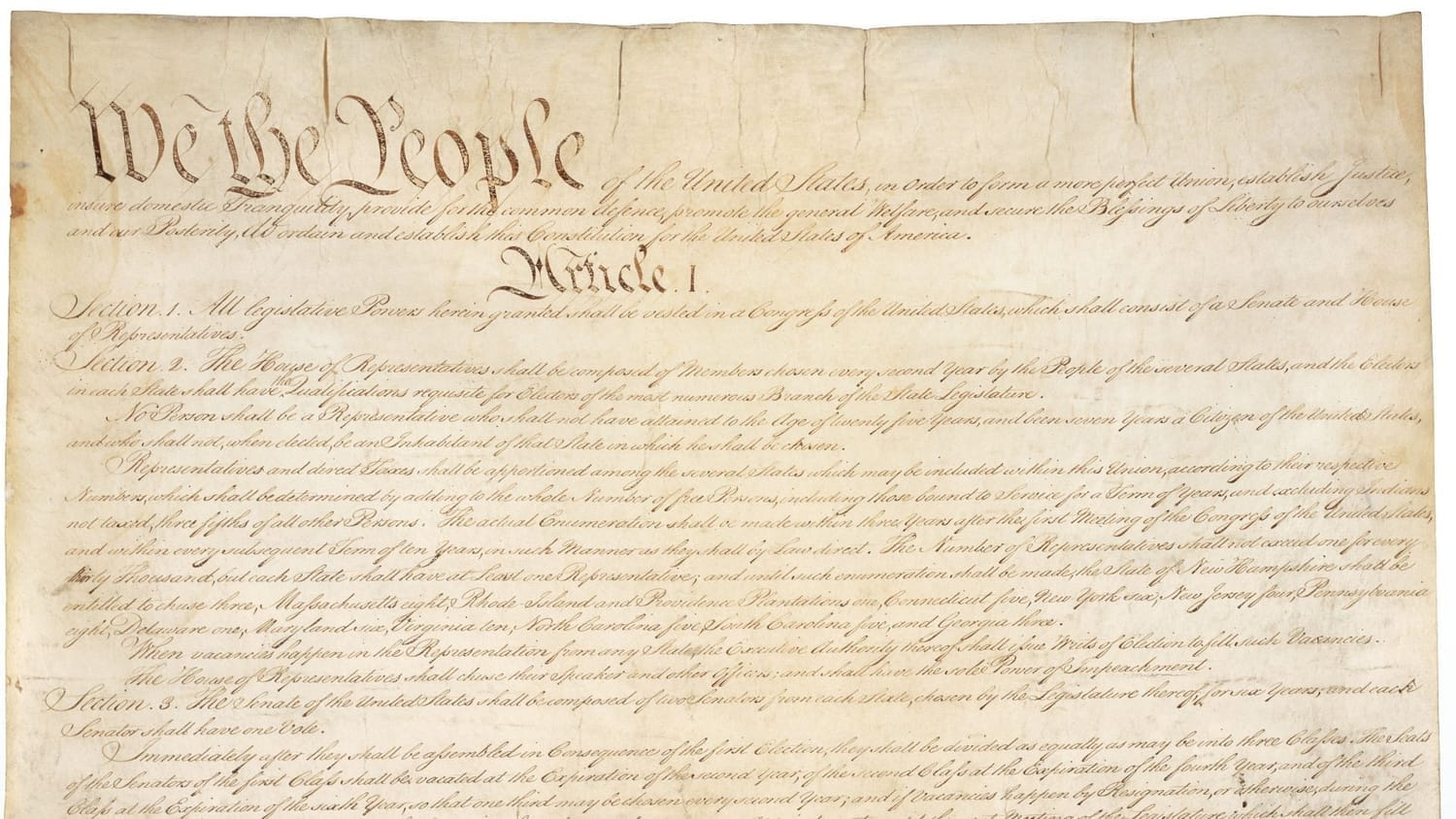
I’m sure you recognize the Preamble of the Constitution. Such a marvelous document but one that we probably haven’t really thought about for years. I remember studying the Constitution and the Revolution back in school – more years ago than I care to admit to. But, now that I am confronted with all that is going on now in our Country, I believe it is time to relook at the Constitution and try to better prepare for its defense.
Of course, there are so many important issues confronting us today that it is difficult to pick just one. So, I have decided to pick one a week or every other week to look at an issue that the Constitution actually covers to see what is actually happening.
I am not an attorney. I am an 81-year-old trying to understand why my country is being subjected to this mean and petty cruelty. You may not agree with me – that is okay as I probably don’t agree with you. But, as we will discover, the Constitution entitles us to our own beliefs.
My first review will look at Article One. This section of the Constitution establishes the three sets of our government – the Legislative, made up of the Senate and the House of Representatives; the Judicial, which is the Supreme Court and the eventual establishment of lower courts; and finally the Executive, the President and Vice President. I remember in school being taught that this is like a three-legged stool – you remove one leg and the stool will collapse.
It seems to me that we are looking at this three-legged stool and trying to keep it upright. Why? The House and Senate do not seem to be working hard at keeping the three legs sturdy. The Judiciary is being overwhelmed with lawsuits and is trying to provide stability. The Executive Branch, i.e. the President, seems to me to be trying to cut off the legs of the Legislature and Judicial branches. This does not support our Constitution, which all participants in these three branches swear an oath to defend.
You cannot sustain a three-legged balance when only one branch is defending the Constitution. Don’t get me wrong, I know there are individuals in the Legislative Branch that are trying to support and defend the Constitution. However, they are not in the majority. The Executive Branch is trying to take over the functions of the Legislative Branch and to minimize the Judicial Branch. That is not in the Constitution!
Just to clarify, here is what the Constitution defines as the duties and responsibilities of the Legislative Branch:
Section 8.
The Congress shall have Power To lay and collect Taxes, Duties, Imposts and Excises, to pay the Debts and provide for the common Defense and general Welfare of the United States; but all Duties, Imposts and Excises shall be uniform throughout the United States;
To borrow Money on the credit of the United States;
To regulate Commerce with foreign Nations, and among the several States, and with the Indian Tribes;
To establish a uniform Rule of Naturalization, and uniform Laws on the subject of
Bankruptcies throughout the United States;
To coin Money, regulate the Value thereof, and of foreign Coin, and fix the Standard of Weights and Measures;
To provide for the Punishment of counterfeiting the Securities and current Coin of the United States;
To establish Post Offices and post Roads;
To promote the Progress of Science and useful Arts, by securing for limited Times to Authors and Inventors the exclusive Right to their respective Writings and Discoveries;
To constitute Tribunals inferior to the supreme Court;
To define and punish Piracies and Felonies committed on the high Seas, and Offences against the Law of Nations;
To declare War, grant Letters of Marque and Reprisal, and make Rules concerning Captures on Land and Water;
To raise and support Armies, but no Appropriation of Money to that Use shall be for a longer Term than two Years;
To provide and maintain a Navy;
To make Rules for the Government and Regulation of the land and naval Forces;
To provide for calling forth the Militia to execute the Laws of the Union, suppress Insurrections and repel Invasions;
To provide for organizing, arming, and disciplining, the Militia, and for governing such Part of them as may be employed in the Service of the United States, reserving to the States respectively, the Appointment of the Officers, and the Authority of training the Militia according to the discipline prescribed by Congress;
To exercise exclusive Legislation in all Cases whatsoever, over such District (not exceeding ten Miles square) as may, by Cession of particular States, and the Acceptance of Congress, become the Seat of the Government of the United States, and to exercise like Authority over all Places purchased by the Consent of the Legislature of the State in which the Same shall be, for the Erection of Forts, Magazines, Arsenals, dock-Yards, and other needful Buildings;—And
To make all Laws which shall be necessary and proper for carrying into Execution the foregoing Powers, and all other Powers vested by this Constitution in the Government of the United States, or in any Department or Officer thereof.
It just seems to me that our current President believes himself to be also our legislature/law maker. To my layperson sense, this is wrong and needs to be corrected. The President does not make the laws. Congress establishes the laws. For example, President Trump is taking actions that seem to be attempts to override or sidestep Congress. This perception stems from several recent executive decisions and policy moves that have raised legal and constitutional concerns:
The Trump administration sought to freeze federal funds appropriated by Congress. A federal judge determined this action was unconstitutional, explaining that the executive branch does not have the authority to withhold funds allocated by the legislative branch.
An executive order was issued directing federal agencies to stop enforcing civil rights laws that prohibit "disparate impact" discrimination. This move has been criticized for undermining protections against systemic discrimination. Reuters
President Trump released a budget proposal with significant cuts and indicated he might withhold funds approved by Congress if his proposals aren't adopted, raising concerns about potential impoundment, which is generally prohibited under the Impoundment Control Act. The New Republic
An executive order was signed to overhaul U.S. elections, including requiring documentary proof of citizenship to register to vote and threatening to pull federal funding from non-compliant states. Legal challenges argue this oversteps federal authority and infringes on states' rights. AP News+1Campaign Legal Center+1
These actions have led to debates on executive authority and the separation of powers. Executive orders can direct federal agencies but cannot violate existing laws or the Constitution. Some of these orders have faced legal challenges, with courts blocking or reversing certain actions. These moves contribute to the view that President Trump is trying to bypass Congress's authority. Legal proceedings and legislative responses will clarify executive power limits.
Let’s get back to the Constitution!
Next time I want to look in depth at Section 9 of Article I – and why this is important now. So, for now, I will continue to review and research all the events that are happening. I know it is difficult as there are so many. This is why I have decided to join and work with Allied We Can a grassroots organization “committed to defending democracy against division, disinformation, & authoritarian threats. Our mission is clear: educate, organize & mobilize.”